
Online or In-Person Therapy: How to Choose What Is Right for You
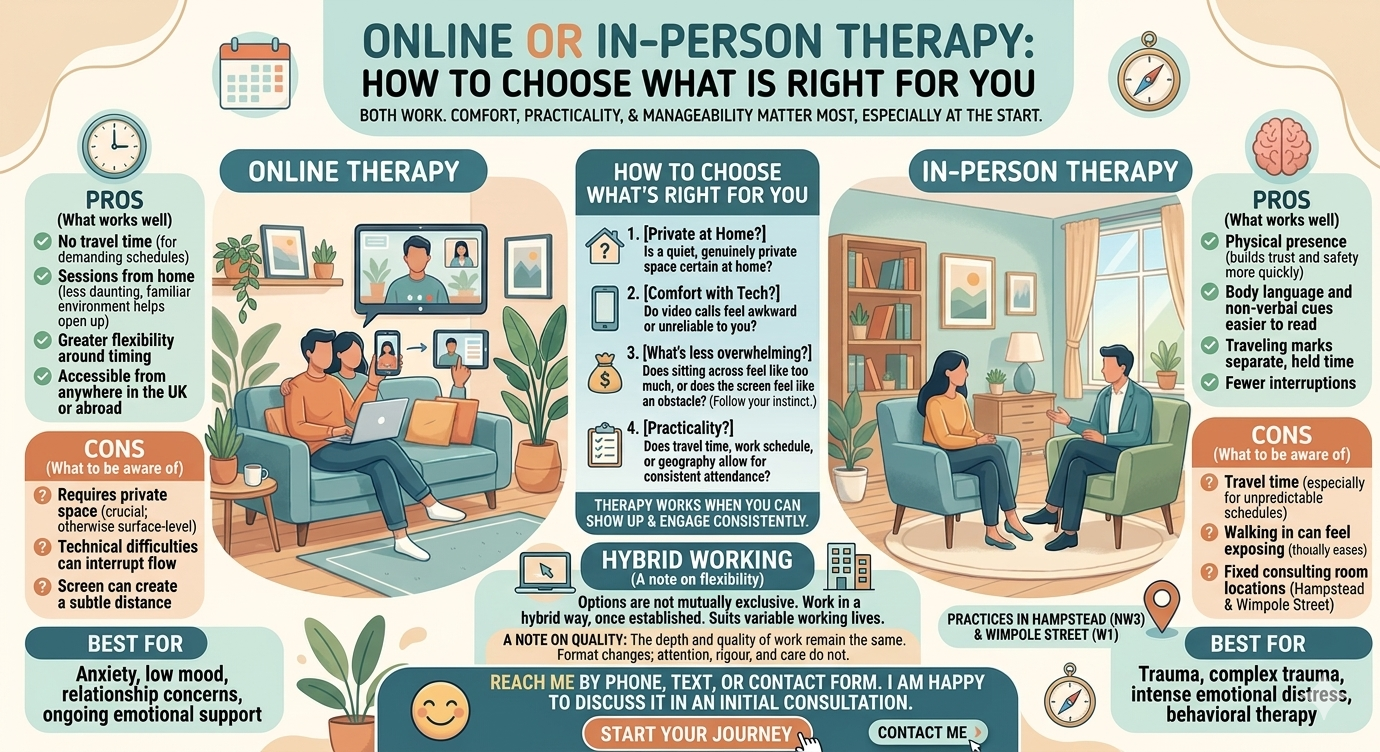
When you have decided to start therapy, a second question usually follows quickly: should it be online or in person?
There is no shortage of opinions on this. Some people feel strongly that nothing replaces being in the same room. Others find that working from their own space allows a particular kind of openness. The research broadly supports both. But research is not the whole story: comfort, practicality, and what feels manageable are just as important, particularly at the beginning.
This piece is intended to help you think it through.
Online Therapy
Online therapy, typically conducted via video call, has become a well-established way of working. For many people it removed a barrier that previously stopped them from seeking support at all.
What works well about it:
• No travel time, which matters for people with demanding schedules
• Sessions can be taken from home, which some people find less daunting
• Greater flexibility around timing
• Accessible from anywhere in the UK or abroad
What to be aware of:
• It requires a private space where you can speak freely, without that, sessions can stay surface-level
• Technical difficulties occasionally interrupt the flow
• Some people find the screen creates a subtle distance they don’t want
Online therapy tends to work particularly well for anxiety, low mood, relationship concerns, and ongoing emotional support. Many clients find that being in a familiar environment actually helps them open up.
In-Person Therapy
There is something distinct about walking into a room set aside entirely for this purpose. A dedicated consulting space which is separate from the rest of your life can itself feel containing.
What works well about it:
• The physical presence of another person can build trust and a sense of safety more quickly for some clients
• Body language and subtle non-verbal cues are easier to read and work with
• The structure of travelling to a session and returning home can help mark it as separate, held time
• Fewer interruptions
What to be aware of:
• Travel time is a real consideration, particularly for those with unpredictable schedules
• Walking into a consulting room for the first time can feel exposing though this usually eases quickly
I see clients in person at my practices in Hampstead (NW3) and Wimpole Street, Marylebone (W1), both of which are easily accessible by public transport.
How to Choose
Honestly, there is no universally correct answer. Both formats can support meaningful, lasting therapeutic work. The question is what will actually allow you to show up and engage with the process.
A few things worth considering:
Privacy at home. Online therapy only works well if you have somewhere quiet and genuinely private. If that is uncertain, in-person may be the more straightforward option.
Your comfort with technology. If video calls feel awkward or unreliable, that friction will carry into sessions. It is worth being honest about this.
What feels less overwhelming right now. For some people, the idea of sitting across from a therapist in person feels like too much at the start. For others, the screen feels like an obstacle. Neither instinct is wrong, follow it.
Practicality. Travel time, work schedules, and geography are legitimate factors. Therapy works when you can actually get to it consistently.
Hybrid Working
It is also worth knowing that these two options are not mutually exclusive. Some clients work in a hybrid way: meeting in person when schedules allow and online when they don’t. This suits people whose working lives are variable, and it can work well once a therapeutic relationship is established.
A Note on Quality
Whether we meet in person or online, the depth and quality of the work remains the same. The format changes; the attention, the rigour, and the care do not.
If you would like to talk through which option might suit you, I am happy to discuss it as part of an initial consultation. You can reach me by phone, text, or through the contact form on this site.