
Fighting a Mental Battle Silently? Seven Signs It Might Be Time to Seek Therapy
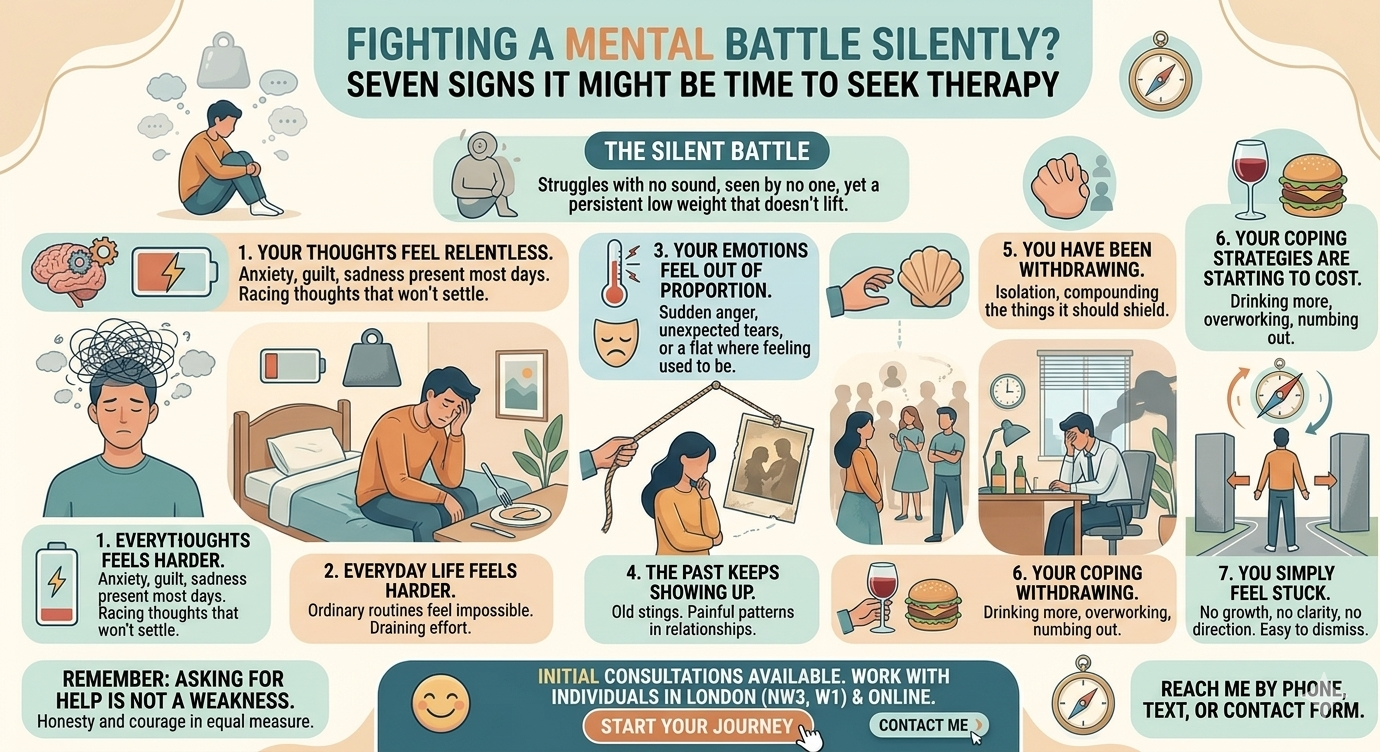
Some struggles make no sound. Nobody sees them. Nobody asks. And yet they are there every day, a low, persistent weight that doesn’t lift, whatever you do.
Managing alone can feel like the only option, or even a point of pride. But there comes a point were carrying everything quietly stops working. When that point arrives, therapy stops feeling optional and starts feeling necessary.
Here are seven signs that it might be time to reach out.
1. Your thoughts feel relentless
Everyone worries. But when anxiety, guilt, or sadness are present most days, when thoughts race and won’t settle, when the mind won’t give you any peace, that is no longer ordinary stress. It is worth taking seriously, and it is something therapy can genuinely help with.
2. Everyday life feels harder than it should
Getting up feels like an effort. Simple tasks feel disproportionately draining. Motivation has quietly disappeared. When ordinary routines start to feel impossible, it is often a sign that something beneath the surface needs attention, not more willpower.
3. Your emotions feel out of proportion
Sudden anger. Unexpected tears. Or a flatness where feeling used to be. When reactions feel bigger or smaller, than situations seem to warrant, something deeper is usually asking to be understood. Therapy creates the space to explore that without judgement.
4. The past keeps showing up in the present
Old experiences that still sting. Relationships that follow the same painful patterns. A sense that childhood has never quite finished influencing who you are now. When the past continues to shape present life in ways that feel limiting or confusing, therapy can help you understand and loosen those connections.
5. You have been withdrawing
Pulling away from people. Avoiding conversations that once felt easy. Choosing silence over connection, not because you want to but because engagement feels like too much. Isolation tends to feel protective at first. Over time, it compounds the very things it was meant to shield against.
6. Your coping strategies are starting to cost you
Overworking. Emotional eating. Drinking a little more than you used to. Numbing out. These patterns are not character flaws. They are usually intelligent responses to pain that has nowhere else to go. But they have a cost. Therapy helps explore what they are managing, and what might replace them.
7. You simply feel stuck
Sometimes there is no dramatic crisis. Just a quiet, persistent sense of not moving. No growth. No clarity. No real sense of direction. This kind of stuckness is easy to dismiss but it is worth paying attention to. It often means something is ready to shift, if given the right conditions.
Asking for help is not a weakness
There is a persistent and unhelpful belief that difficulty should be managed alone and that needing support is a failure of some kind. It isn’t. Reaching out for therapy is an active choice to understand yourself more clearly and live more fully. It takes honesty and courage in equal measure.
I am a BACP registered psychotherapist with practices in Hampstead and Wimpole Street, London, and I also work online. I work with individuals navigating a wide range of difficulties including many who have managed alone for longer than they needed to.
If any of the above felt familiar, an initial consultation is a good place to start. You can reach me by phone, text, or through the contact form on this site.