
Understanding Anxiety: What It Is and How Therapy Can Help
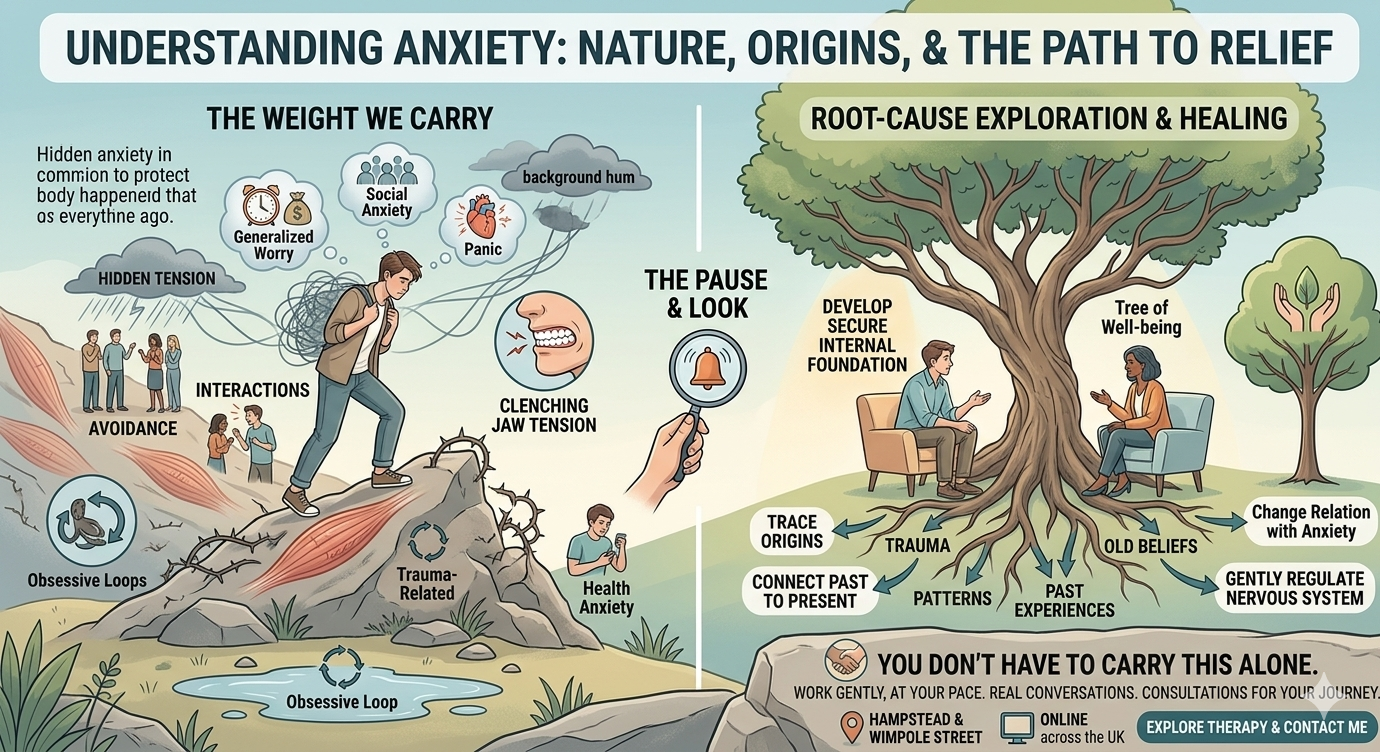
Anxiety isn’t always obvious. Sometimes you’re the capable one. The reliable one. The person who gets things done, shows up, and holds things steady. And yet inside, something feels tight. Wired. Like your body forgot how to properly switch off.
On paper, everything might look fine. Work is manageable. Relationships are okay. Nothing dramatic is happening. And yet there’s a background noise, a quiet, persistent hum. A low-level alert system that doesn’t seem to power down, whatever you do.
This isn’t about labelling you or handing out diagnoses through a screen. It’s a pause. A moment to look honestly at what anxiety actually is and what might genuinely help.
The Many Ways Anxiety Shows Up
Anxiety doesn’t wear one uniform. It shifts, and it presents differently in different people. You might recognise:
Generalised anxiety — persistent worry about work, money, health, relationships, or simply everything at once
Social anxiety — fear of saying the wrong thing, being judged, or replaying conversations long after they’ve ended
Panic episodes — sudden waves of fear accompanied by racing heart, dizziness, or breathlessness
Health anxiety — interpreting ordinary physical sensations as something more serious
Obsessive loops — intrusive thoughts that stick, or rituals that feel necessary to manage uncertainty
Trauma-related anxiety — feeling perpetually on edge, easily startled, or hyper-aware of your surroundings
Some people recognise themselves immediately in one of these. Others see bits of themselves in several. It’s rarely neat, and it doesn’t need to be.
Anxiety Lives in the Body — Not Just the Mind
This part often gets overlooked. Anxiety isn’t purely psychological; it is physical. Common signs include:
Shoulders that never quite drop
Jaw tension or teeth clenching
Shallow or constricted breathing
Digestive problems or a churning stomach
Restlessness, or feeling oddly frozen
Snapping at people you actually care about
Avoiding situations that once felt manageable
This isn’t weakness. It is a nervous system doing what it learned to do — trying to protect you. Often, that learning happened a long time ago.
Symptom Relief Is Not the Same as Root-Cause Work
Breathing exercises help. Grounding techniques matter. But if anxiety keeps returning, it is usually because it has roots in experiences, patterns, old beliefs about safety, worth, and control that were formed before you had the words for them.
You can quiet symptoms temporarily without understanding where they began. And when that happens, they tend to resurface in a different situation, with the same internal alarm.
That is where psychotherapy works differently.
How Psychotherapy Helps With Anxiety
Therapy is not about telling you to think positively or push through. It is about curiosity and about understanding your anxiety rather than simply managing it.
Together, we might:
Trace when the anxiety first began, and what was happening at the time
Notice patterns in relationships, work, or how you relate to yourself
Understand what triggers the alarm — and why
Connect past experiences to present fears
Gently work with the nervous system to build greater steadiness
Develop a more settled, secure internal foundation
The aim is not to eliminate anxiety entirely, that would be neither realistic nor, in truth, desirable. Anxiety carries information. The aim is to change your relationship with it. To reduce its intensity. To understand what it is trying to signal. When anxiety is understood, it often softens, not dramatically, but enough.
You Don’t Have to Keep Carrying This Alone
Anxiety often means you have been holding a great deal for a long time. Keeping things steady. Showing up. Coping in ways most people around you don’t even notice.
As a psychotherapist working in Hampstead and Wimpole Street, London — and online across the UK, I work at your pace, with care and without clinical coldness. If something in this resonated, it may be worth exploring further.
I offer an initial consultation to talk through what you are carrying and whether therapy might help. You can reach me by phone, text, or the contact form on this site — I am glad to hear from you.